

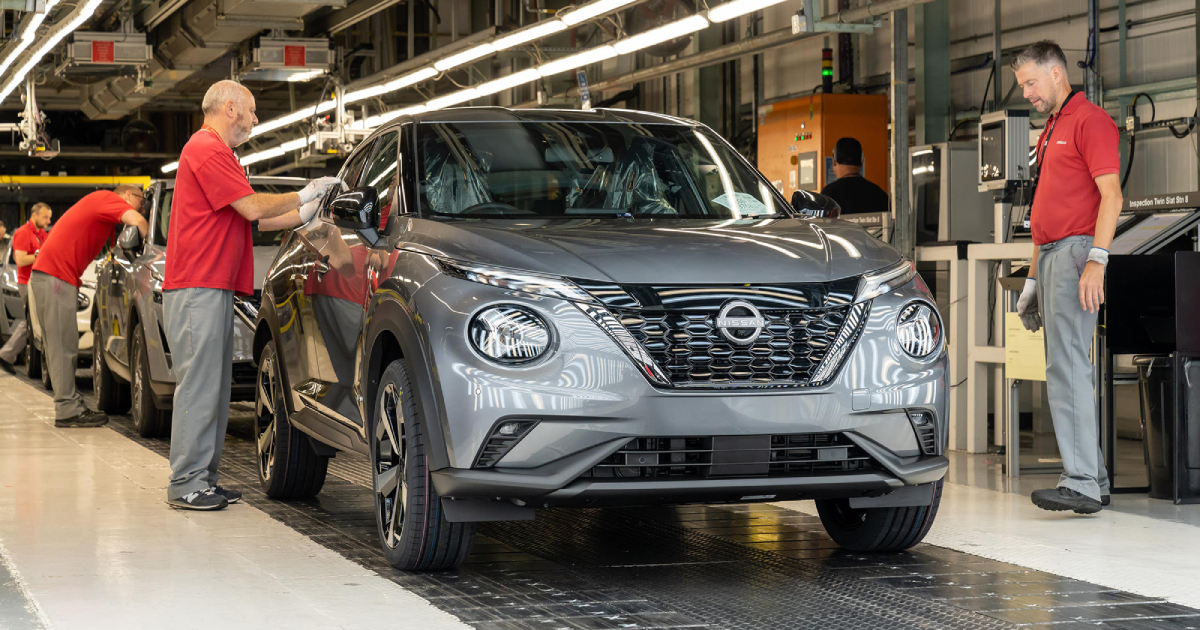
Nissan is consolidating production at its Sunderland, England plant — the UK's largest car factory — from two lines down to one, as part of a sweeping European cost-cutting plan that will eliminate roughly 900 jobs across the continent. The move underscores how much pressure the Japanese automaker is facing globally, with seven plant closures already announced worldwide and US import tariffs adding to the headwinds. For buyers of Nissan's Rogue and other models, the restructuring signals a brand working hard to stay relevant.
Output in free fall
Sunderland built 273,174 vehicles in 2025 — less than half the 500,000-plus it produced at its historical peak, leaving the facility running at roughly 50% capacity despite a £450 million investment in EV production. The Leaf electric hatchback, Juke crossover, and Qashqai crossover are all built there; under the restructuring, all 3 models will consolidate onto a single line. That line will shift to a three-shift schedule to partially offset the capacity loss. Line 1 closes in the second half of 2026, though Nissan has not set an exact date.
The company says no assembly-floor jobs at Sunderland will be cut directly, but fewer than 50 UK office roles are expected to be eliminated as part of the broader European reduction. The bulk of the 900 cuts — around 500 — fall in Spain, where Nissan is also partially closing a Barcelona parts warehouse and shifting Nordic-region distribution to a local-importer model.
Chinese brands closing the gap
The restructuring reflects a broader market reality. Nissan's UK market share dropped to 3.7% in January–April 2026, down from 5.6% in 2016 — per SMMT, the UK's official auto trade body. Over that same period, Chery climbed to nearly 5% of the UK market through its Jaecoo, Omoda, and Chery-branded models. MG holds about 4%, and BYD has reached 3.45%.
Nissan is now in talks with Chery and Dongfeng about leasing the idled second line — a deal the automaker says could preserve jobs and lift total site output. Chery has already moved to establish a CKD (completely knocked-down, meaning vehicles assembled locally from imported kits) plant in Barcelona, lending some credibility to the UK talks. No agreement has been signed, and timing remains open, reports Autocar.
What it means for the brand
Sunderland still holds strategic importance for Nissan. A new electric Juke — backed by UK government support — is slated to launch later this year, with a full EV Juke expected around 2027. The Qashqai's EV timeline is less certain, with Nissan pursuing a dual strategy of battery-electric and e-Power (a hybrid system where an internal-combustion engine generates electricity for a motor-driven powertrain) variants. None of the Sunderland-built models are sold in the US, but the plant's struggles reflect the same global pressures — Chinese competition, slowing EV demand, and tariff uncertainty — that are reshaping Nissan's lineup worldwide.

