

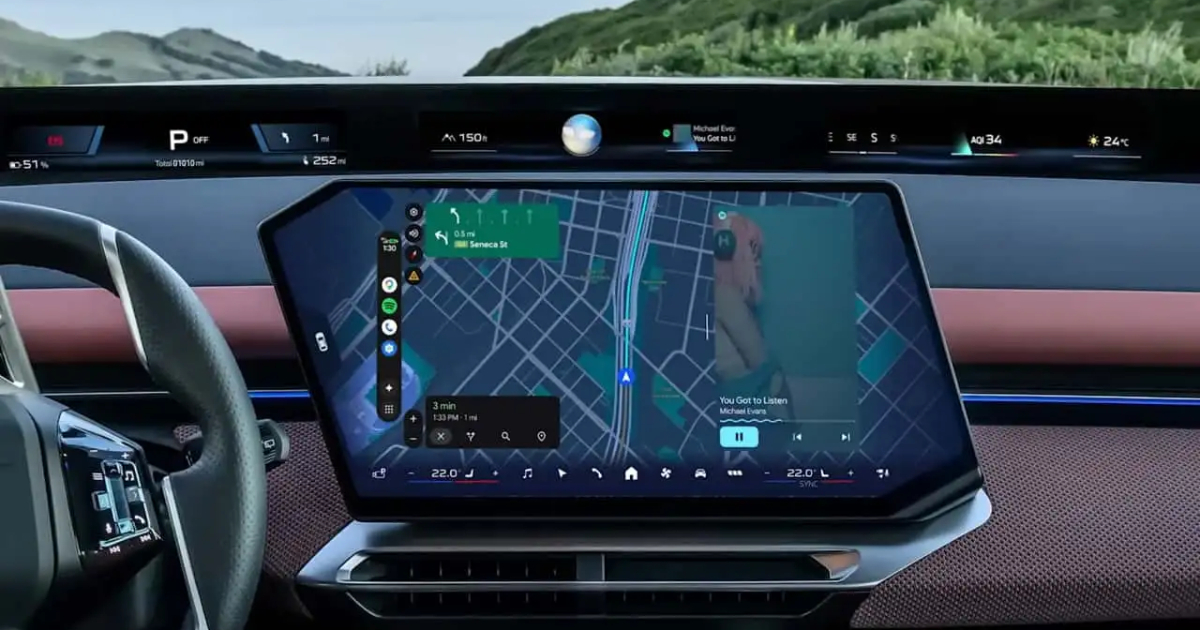
Google is overhauling Android Auto for the first time in 11 years, and the most visible change is one that should have arrived long ago: the interface finally fills every inch of the screen. No more black bars.
The update adapts the layout to any display shape — circular screens like Mini's, irregular panels like the Lucid Air's, and trapezoidal setups like the BMW iX3's. Wherever Google Maps used to leave dead space at the edges, it now stretches corner to corner. Pinned widgets sit on top of the navigation view, so drivers can see a route and music controls — or a calendar item or garage-door button — at the same time. Large displays can stack two widget rows.
3D navigation, rebuilt from scratch
The new Immersive Navigation mode is what Google is calling the biggest Google Maps update in over a decade. Streets gain depth: buildings, overpasses, and terrain are rendered in 3D, and the system highlights lanes, traffic lights, and stop signs in real time as the car approaches them.
Full HD video — only when parked
Later this year, Android Auto will support Full HD video at 60 fps on center-stack displays. Ford, Genesis, Hyundai, Kia, BMW, Mercedes-Benz, and Volvo are among the first brands confirmed. Playback is locked to parked mode, but Google built in a sensible transition: when the car moves, the picture drops and audio continues in the background — provided the app supports it.
Dolby Atmos spatial audio support is also coming, initially to vehicles from BMW, Genesis, Mercedes-Benz, and Volvo, among others.
Gemini steps in as the in-car assistant
The second half of 2026 brings Gemini Intelligence to Android Auto for users with access to it. Google says Gemini will read context from messages, email, and calendar — so if someone texts an address, the system can locate it and draft a reply automatically. It will also handle tasks like ordering food through DoorDash without requiring the driver to open the app manually.
No US-specific rollout date has been confirmed yet; Google says the features arrive across supported vehicles in the second half of 2026, — per the Google blog.

