

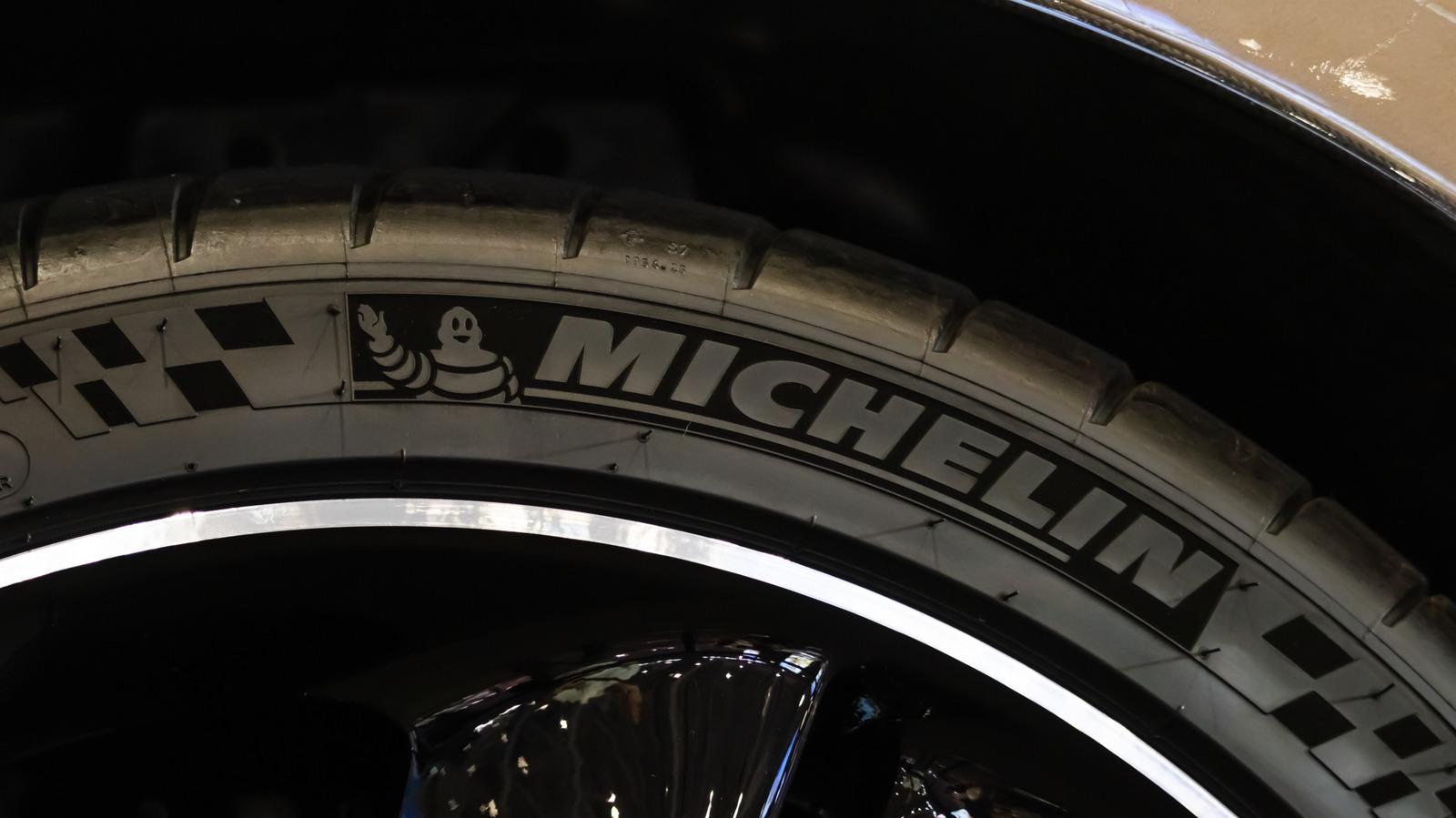
Michelin tyre sidewall with sidewall markings. Photo: carscoops.com
If you look closely at modern rubber, you might be driving on microchips without knowing it. Michelin has been embedding passive radio frequency identification (RFID) tags directly inside its tyres, placing the chip and antenna between protective rubber layers to survive the tyre’s entire lifecycle. While the move has raised privacy questions among motorists, the technology works as an industrial inventory tool rather than a vehicle tracker.

Michelin company logo sign. Photo: carscoops.com
A digital passport in rubber
The tag itself is completely passive and contains no battery. Instead, it draws power solely from the radio waves emitted by a nearby reader. Once programmed at the factory, the data is permanently locked. The chip stores an individual serial number alongside a company prefix and product reference, allowing scanners to pull up the brand, tyre dimension, and product description through Michelin's data service.
For tyre makers and workshops, this creates a digital paper trail from manufacturing and warehouse logistics through to dealer servicing and eventual recycling. According to Michelin, the goal is to connect all tyres across passenger cars, light commercial vehicles, heavy trucks, and buses. The French manufacturer began fitting chips to select passenger tyres in mid-2019, having already equipped up to 90% of its commercial truck tyres.
Stacked tyres in warehouse storage. Photo: carscoops.com
What the chips cannot monitor
Crucially, an RFID tag is not an active sensor. It cannot read tyre pressure, monitor running temperature, or tell you how much tread depth remains before failing an inspection. Gathering that telemetry still requires dedicated tyre pressure monitoring sensors or active hardware.
Fears about real-time driver surveillance are also overstated. Even with access to scan logs and a Michelin tire database, tying an individual tyre's RFID tag to a specific driver would be difficult.
Across the wider industry
Michelin is not alone in digitising tyre tracking. According to Continental, it also embeds tamper-proof RFID chipsets carrying unique SGTIN-96 identifiers into tyres for logistics, keeping the technology distinct from its active ContiConnect monitoring sensors. Meanwhile, systems that actively feed live tyre dynamics into vehicle stability controls, such as Pirelli Cyber Tyre fitted to supercars like the McLaren Artura and Pagani Utopia, rely on dedicated powered sensors rather than basic passive tags.

