

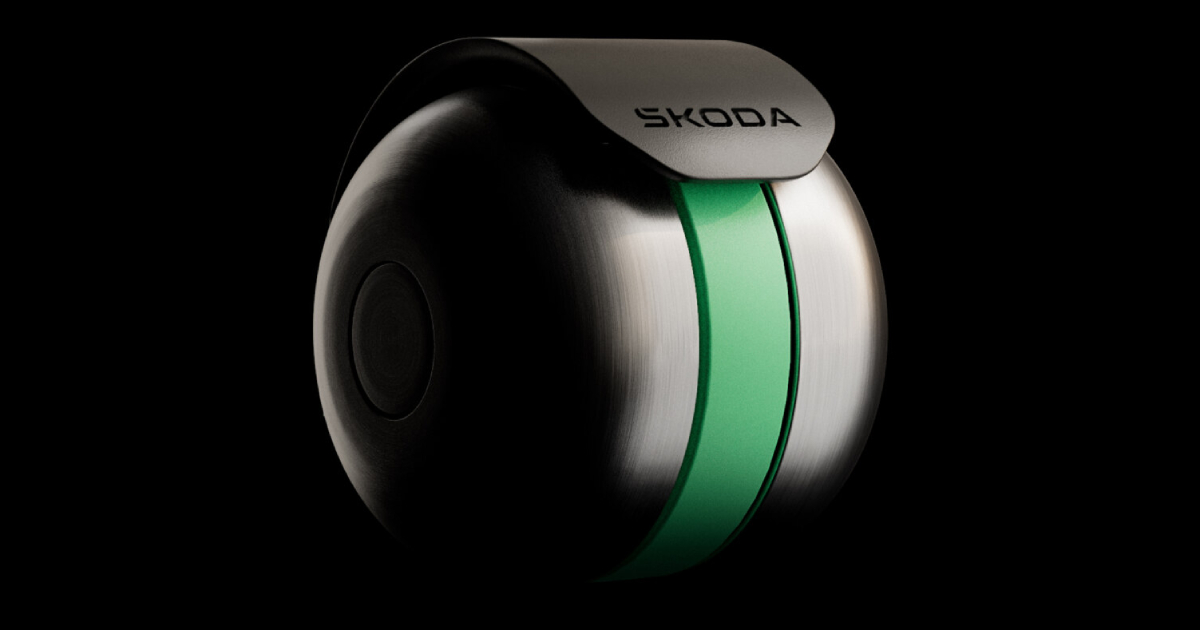
Škoda DuoBell — is a new bicycle bell developed in collaboration with acousticians from the University of Salford. The design is completely mechanical, no electronics — but it is this design that allows the bell to break through active noise cancellation (ANC) algorithms in modern headphones.
The conventional bike bell hasn’t changed in over a hundred years. But the streets have changed: according to Transport for London, the number of collisions between cyclists and pedestrians in London increased by 24% in just 2024. One of the key factors is the widespread use of ANC headphones. Up to half of pedestrians on London streets use such headphones. Many models block external sound so effectively that a standard bike bell simply cannot be heard through them.
Where the algorithm fails
ANC works like this: headphones detect external noise and generate an opposite sound wave that neutralizes it. The technology handles uniform low-frequency sounds well — for example, the hum of an airplane or air conditioner. But there are vulnerabilities.


Škoda DuoBell
Researchers at the University of Salford discovered a narrow frequency band — from 750 to 780 Hz — that noise-canceling algorithms consistently cannot suppress. This range became the basis for DuoBell.
The bell has two resonators: the first is tuned to the ANC "blind spot" in the 750–780 Hz range, while the second is tuned to a higher frequency, closer to the sound of a regular bell. In addition, a special impact mechanism delivers frequent and irregular hits. This combination generates sound waves that noise cancellation algorithms simply cannot process quickly enough.
Testing numbers
Tests in virtual reality environments and on real streets of London showed: pedestrians in ANC headphones heard DuoBell 22 meters earlier and 5 seconds sooner than a regular bell. Real testing involved Deliveroo couriers — and according to Škoda, after the trials, they wanted to keep the bells for themselves.
A concept, but with open data
DuoBell remains a concept for now — it is not for sale and is not expected to be in the near future. However, Škoda does not plan to keep the development behind closed doors. The company plans to publish the results of the acoustic research in open access so that any bike bell manufacturer can use this knowledge.
This fundamentally distinguishes DuoBell from a typical corporate PR project. If the data does indeed become public, the technology could appear in serial bells — and no longer from Škoda.
Roots in bikes
The fact that a car manufacturer decided to tackle a bike bell does not seem so surprising if you know: more than 130 years ago Škoda started with bicycle production. The company is still present in cycling: it is an official partner of the Tour de France, La Vuelta, Paris–Roubaix, and Liège–Bastogne–Liège, and in 2026 also became a partner of the Union Cycliste Internationale (UCI) for the mountain and gravel biking world championships.

