

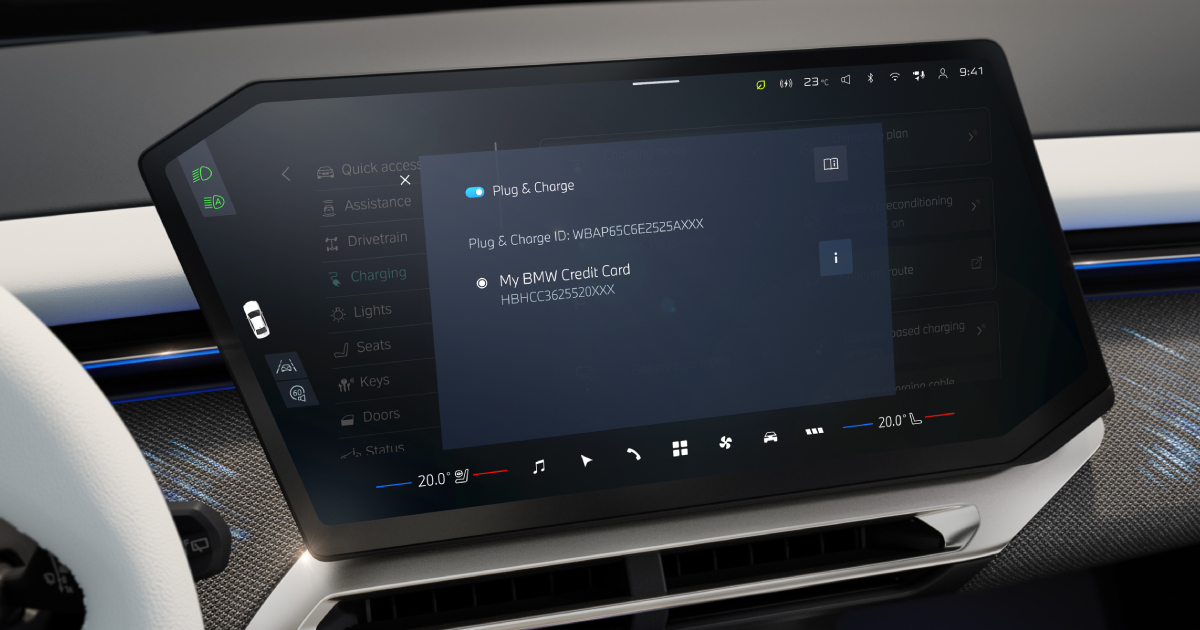
BMW together with Mini is launching a new Plug&Charge format in Germany and Austria: charging without a prior contract. Now, the driver can link a bank card directly to the car and pay for the session automatically.
Previously, the system worked differently. The vehicle stored one or more contracts with charging providers and used them for identification and billing. Even with the Multi-Contract Handling function, the driver had to arrange subscriptions in advance.
Now this step can be skipped. Connect the cable — and the charging starts, with payment debited from the card.
Who is this for?
The new approach is designed not only for regular electric car owners. BMW is clearly targeting a broader audience: tourists, corporate car drivers, and those who use the car temporarily.
The logic is simple: the fewer barriers at the start, the more likely a person is to use an electric vehicle without unnecessary "dancing" with apps and charging network cards.
Limitations at the start
There is a nuance: the function does not work at all stations. In the first stage, the service is available through the Mer Deutschland network — over 1,400 charging points in Germany and Austria. Technically, everything is implemented through the Hubject ecosystem, which handles data exchange and payment processing.
Throughout 2026, BMW promises to connect new operators and enter other markets, but without specifics on the scale. So, for now, it’s more of a pilot with the prospect of expansion.
How much does it cost?
Payment is made according to so-called ad-hoc tariffs — effectively the standard operator price without a subscription. In the case of Mer Deutschland, it is €0.69 per kWh at stations with a power of 50 kW and €0.79 per kWh at high-speed HPC (over 150 kW). Prices are displayed directly on the station, in the car, and in the app.
An important point: ad-hoc tariffs are usually higher than in contract plans. So convenience here is exchanged for additional costs.
Context: fewer barriers, more consumption
Plug&Charge has long been considered one of the key tools for simplifying the use of electric vehicles. But the contract requirement held back its spread. BMW is taking a step towards a "like at the gas station" model: drive up, connect, pay. No registrations and bindings to a specific operator.
The only question is whether this will become a mass standard. If other manufacturers and operators pick up the idea, the charging market may become much simpler — although not necessarily cheaper.

