

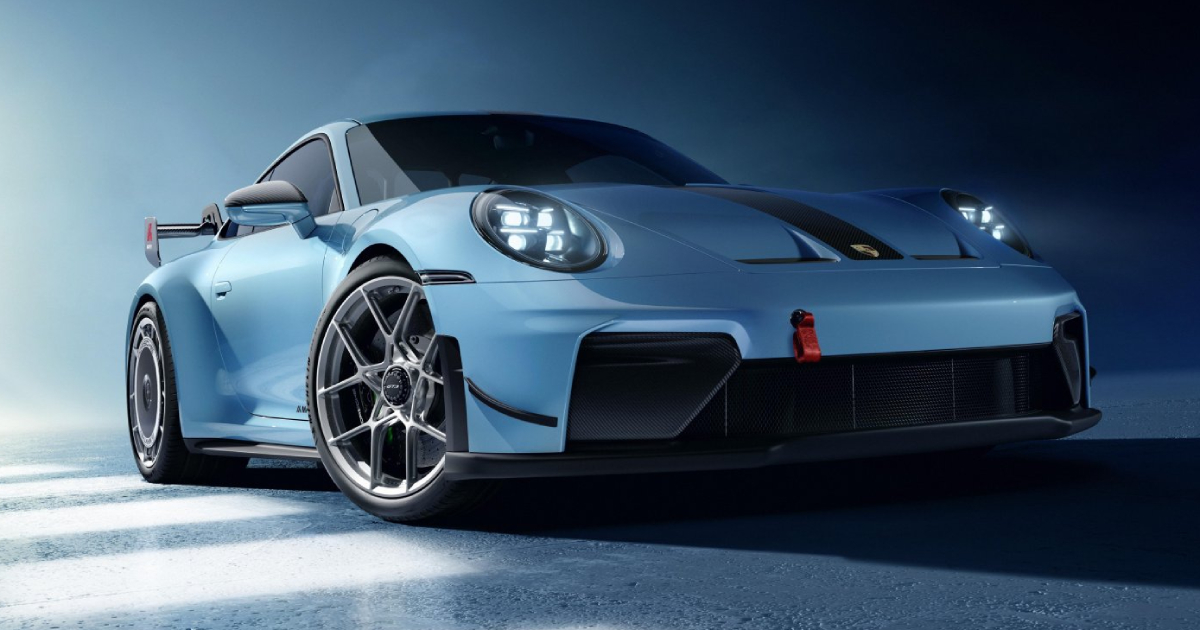
The 911 GT3's signature 4.0-liter naturally aspirated flat-six — the engine Porsche fans have long treated as sacred — is living on borrowed time. EU fleet CO2 rules requiring a 55% emissions reduction by 2030 and 90% by 2035 versus 2021 levels make the high-revving naturally aspirated engine (one with no turbocharger, relying solely on atmospheric pressure) increasingly untenable in Europe. The catch: even though US EPA rules allow a longer runway for performance internal-combustion engines, Porsche almost certainly won't build two separate GT3 powertrains to serve different markets.
What Porsche's GT chief said
Andreas Preuninger, who oversees Porsche's GT lineup, told Car and Driver directly: a turbocharged GT3 is possible. On the NA engine's future, he drew a clear line between markets — in the US, it could survive "quite some time, maybe," while in Europe it likely has "only a few years without substantial changes," — per Motor1's Preuninger interview. That's as close to a countdown as Porsche has given publicly.
The current 992.2 GT3 already required two additional catalytic converters just to clear Euro 6 standards. Euro 7, the next round of EU emissions rules taking full effect in November 2027, sets stricter NOx and particulate thresholds the naturally aspirated engine likely cannot meet without fundamental redesign.
The T-Hybrid path forward
Developing a separate NA engine for the US while building a turbo or hybrid variant for Europe would cost hundreds of millions — money Porsche is already stretching across the electrified 718 replacements and new crossover programs. One powertrain for all markets is the only financially rational move, as Carscoops notes.
The leading candidate is Porsche's T-Hybrid system, already debuted in the refreshed 911 Carrera GTS. It combines a 3.6-liter twin-turbocharged flat-six producing 478 hp (357 kW) with two electric motor assists: a 15 hp unit integrated into the turbocharger to eliminate turbo lag, and a 54 hp motor built into the 8-speed PDK transmission. Combined output reaches 532 hp (397 kW) — more than the current GT3's 502 hp (374 kW).
What this means for buyers
No official timeline exists for the next-gen GT3, and Porsche hasn't confirmed a powertrain decision. But the direction is clear. Buyers who want the current 9,000-rpm, naturally aspirated GT3 experience have the 992.2 generation in front of them now — starting around $169,700 MSRP before options. Whether the T-Hybrid can replicate what makes the GT3 emotionally distinctive — that linear throttle response, that soundtrack — is the real question Porsche still has to answer.

