

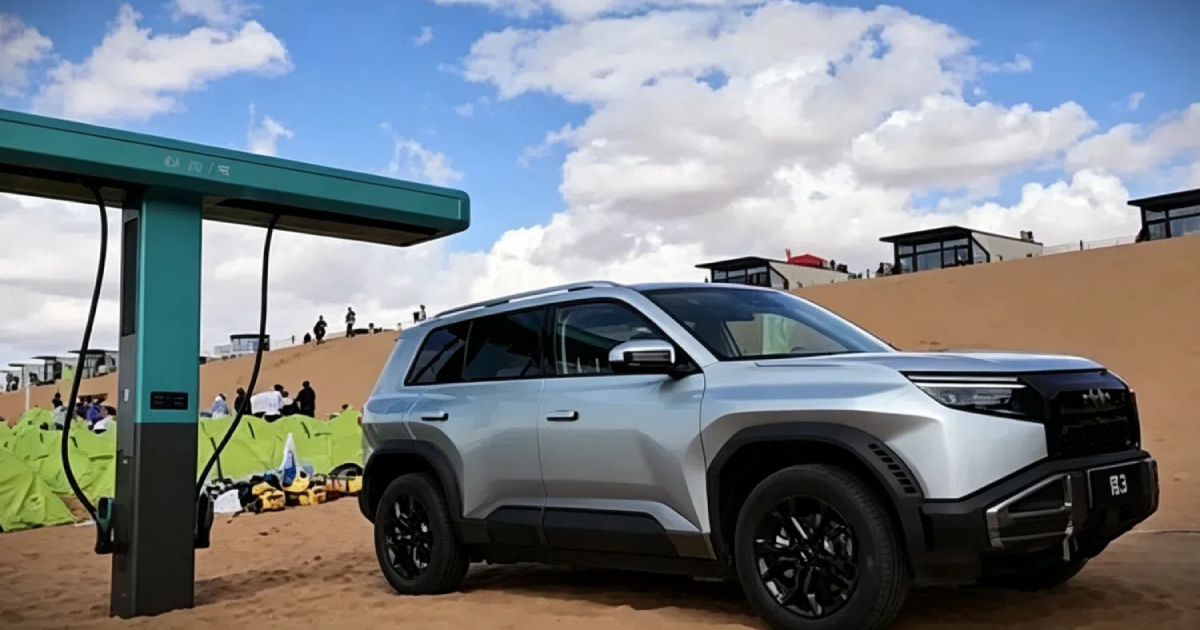
BYD is building what may be the fastest public charging network outside of China — and the US won't see any of it. The Chinese automaker says its 1,500 kW "Flash Charging" stations can replenish a compatible EV from 10% to 97% in roughly 9 minutes, according to a desert demonstration in Inner Mongolia's Tengger Desert. Those figures come from controlled company testing, not an independent or EPA-equivalent benchmark, so treat them as directional.
The real story is how quickly BYD is rolling out infrastructure. The company stood up 5,000 Flash Charging stations inside China within 27 days of the program's launch in early April 2026, reaching 5,715 stations by May. Outside China, BYD plans 6,000 more stations by end-2026, with 3,000 of those in Europe.
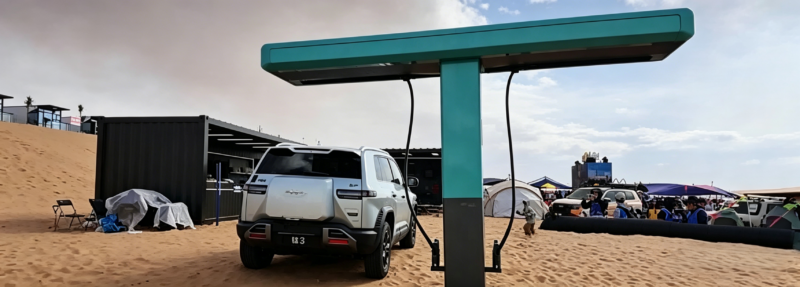 BYD's Flash Charging station in the Tengger Desert. Photo: Autohome
The Denza Z9 GT: Europe's new premium target
The European build-out runs alongside the debut of the Denza Z9 GT — a large electric wagon positioned squarely against the Porsche Panamera Sport Turismo. It opens at €115,000 (including VAT) in Germany and France, slightly undercutting the Panamera's €116,400 entry point. Rated at 599 km on the WLTP standard (the EU's range-test cycle — not EPA), the Z9 GT is also flash-charging compatible. European stations use the CCS2 connector and, notably, are open to non-BYD EVs, though competing vehicles receive lower peak power.
Denza is launching in France, Germany, Italy, Spain, and the UK, with a 30-country expansion targeted by end-2026. Cold-weather performance is a stated selling point: BYD says the system can complete a charge in 12 minutes at −30°C, addressing a legitimate anxiety among European EV buyers.
No US path — tariffs close the door
None of this applies to the US market. BYD vehicles face Section 301 tariffs — layered duties that effectively price Chinese-made EVs out of reach for American dealerships. There is no IRA Section 30D federal tax credit eligibility for BYD products, either, since the credit requires North American final assembly. BYD has no US sales operation and no announced plan to build domestically.
The flash-charging speed figures are still worth watching as a benchmark. For context, the fastest publicly available DC fast chargers in the US today top out around 350 kW for compatible vehicles. BYD's claimed 1,500 kW is more than 4 times that — though matching output requires a vehicle built for it, plus a battery management system and thermal setup that can absorb the load safely.
Meanwhile, BYD's global EV sales hit 314,100 units in April 2026 — up 6.2% from March but down 15.7% year over year, the eighth consecutive month of annual decline — per Electrek and CarNewsChina.

