

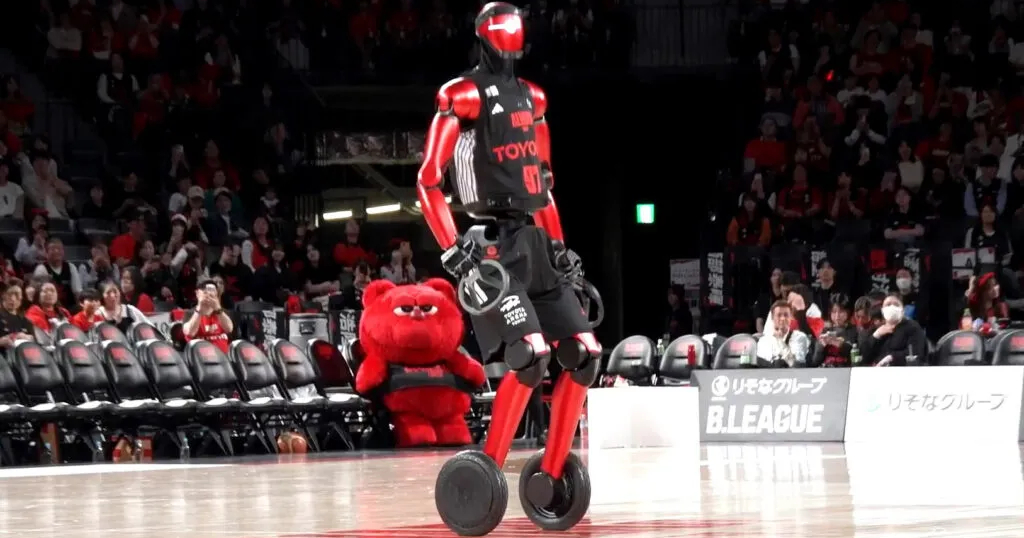
Toyota's CUE7 robot stepped onto a basketball court April 12, 2026, at Toyota Arena Tokyo during a halftime show for an Alvark Tokyo B.League game — dribbling and shooting in front of roughly 8,400 fans. It's a research platform, not a product headed to market, but the technology underneath it has direct ties to where Toyota wants to go with factory automation and autonomous systems.
The CUE project started in 2017 as a voluntary engineering initiative inside Toyota. Early versions were essentially stationary shooting machines. CUE3 made headlines in 2019 by sinking 2,020 consecutive free throws, setting a Guinness World Record for humanoid robots. In December 2024, the CUE6 pushed that further with a confirmed Guinness record for the longest humanoid robot basketball shot: 24.55 meters (about 80.5 feet).
What CUE7 actually does differently
CUE7 is the most significant update to the platform to date. The robot now moves around the court independently and dribbles — capabilities the earlier versions simply didn't have. It stands 7 feet 2 inches tall and weighs 163 lb (74 kg), down from 265 lb (120 kg) in the prior version. It rolls on an inverted two-wheel base rather than walking on legs.
The control system combines reinforcement learning (RL) — where the robot improves through trial and error — with model predictive control (MPC), which anticipates future states to make smoother, faster adjustments. A suite of cameras and lidar sensors handles basket detection, distance calculation, and real-time shot trajectory optimization. That combination lets CUE7 adapt on the fly rather than executing rigid pre-programmed sequences.
The real point isn't basketball
Toyota's Frontier Research Center frames CUE7 explicitly as a testbed for vision systems, motion control, and what researchers call embodied AI — intelligence that responds to a physical environment rather than just processing data. Those are the same capabilities needed for next-generation manufacturing robots and autonomous vehicle perception systems.
Japanese media estimate the cost of a single CUE7 unit at around $150,000. Toyota has not announced any commercial version or deployment timeline. Think of it less like a concept car and more like a rolling lab — the kind of platform where today's experimental control algorithms become tomorrow's production-line software.
Whether CUE7 ever lands a three-pointer in a real game is beside the point. The underlying AI and sensor fusion work is exactly what automakers are racing to develop.

