

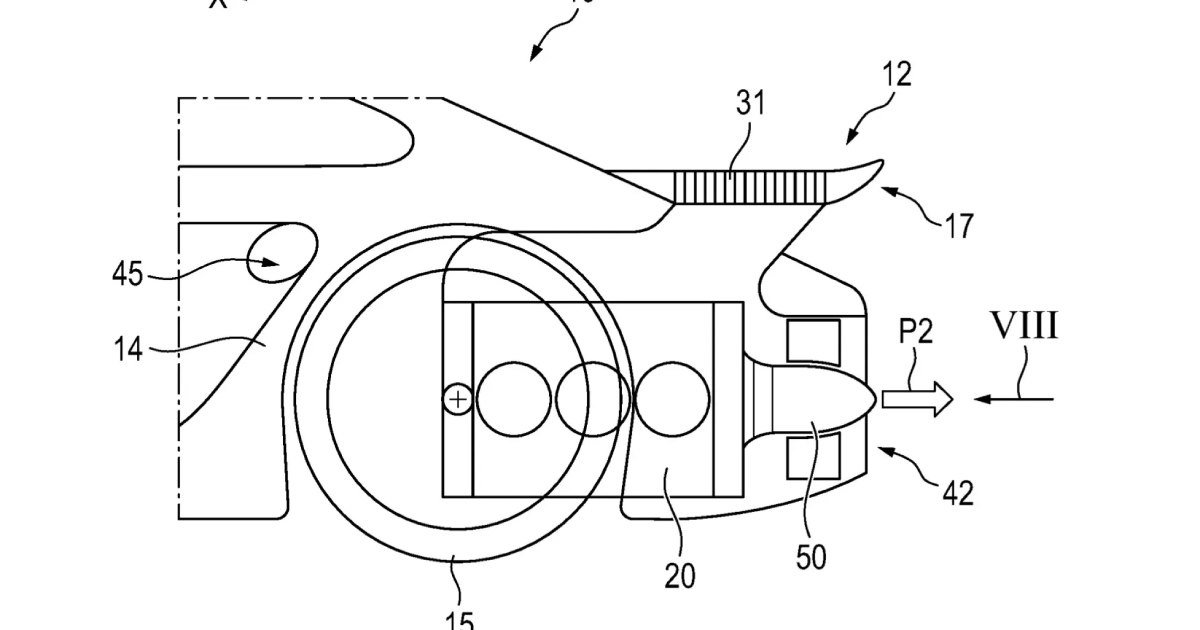
Porsche filed a patent in Germany for a hybrid cooling system that pairs traditional liquid cooling with active ducted airflow routed directly around the engine, turbocharger, and exhaust. The patent, published May 7, 2026, by the German patent office (DPMA), stops well short of a production commitment — but it signals that Porsche's engineers are still exploring ideas rooted in the brand's air-cooled past, — per Carscoops (May 13, 2026).
The last air-cooled 911 — the 993 generation — left production in 1998. Noise, emissions compliance, and the challenge of managing heat on increasingly powerful engines pushed Porsche to liquid cooling with the 996. This new patent doesn't propose going back to pure air cooling. Instead, it describes placing the powertrain inside a dedicated housing that acts as a large air duct. A rear-mounted fan draws air through a radiator, then channels it around the engine block — which, notably, the patent says could include cooling fins on the crankcase, a visual callback to classic flat-six design.


Porsche's patent describes routing air through a dedicated engine housing, with cooling fins on the crankcase echoing the brand's classic flat-six design.
What the system claims to do
Porsche lists several practical benefits. Routing the radiator closer to the engine shortens and lightens coolant lines. Smaller front air intakes become possible, which could improve aerodynamics. A cold-start mode reverses airflow to recirculate exhaust heat, warming the engine faster in low temperatures. The patent also suggests the rear fan could generate additional downforce through controlled airflow — a concept the GMA T.50 supercar has already demonstrated with its large tail-mounted fan.
Where the 2026 911 actually stands
None of this is coming to showrooms anytime soon. The current US 911 lineup — Carrera, GTS, Turbo S, GT3 — uses liquid cooling, and the 2026 models now arriving at dealers are hybrid-focused in a different sense entirely. The 2026 911 Carrera GTS hybrid starts around $170,000 and pairs a turbocharged flat-six with dual electric turbochargers and an integrated e-motor. The Turbo S hybrid starts at $272,650 — per Edmunds (recent). Neither uses the ducted air-cooling system described in the patent.
The noise problem that killed air cooling in 1998 also goes unaddressed in the filing. Fan volume was a central reason Porsche abandoned the concept, and the patent offers no details on how an active rear fan would meet modern noise regulations. Until that question has an answer, the 2026 and 2027 911 hybrids will keep their conventional radiators — and the air-cooled era will remain history.

