

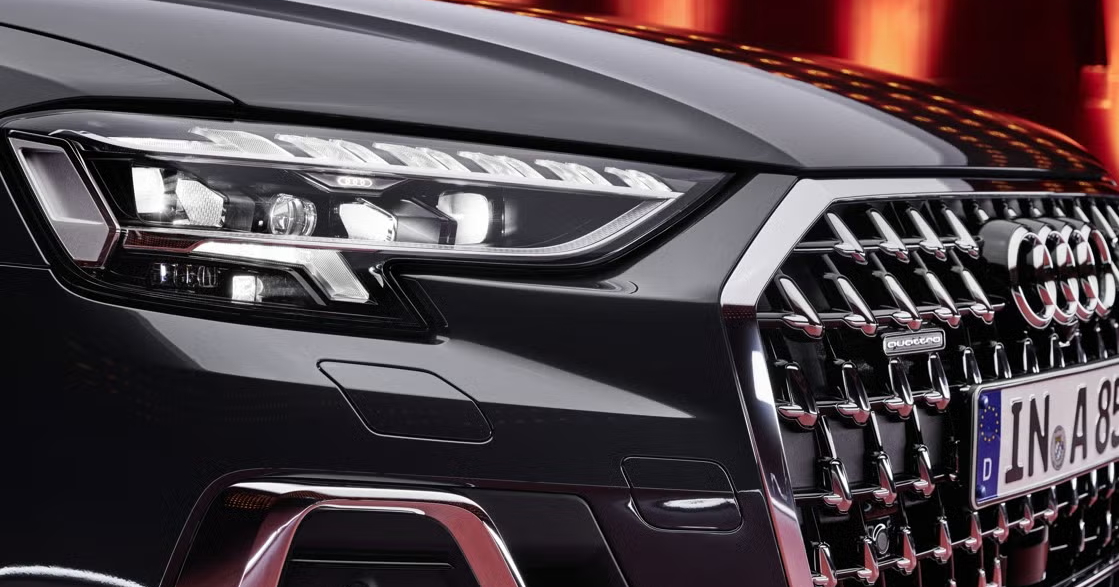
Audi's upcoming Q9 SUV will debut the brand's Digital Matrix LED headlights on US roads for the first time, packing 25,600 individually controlled micro-LEDs per module. The system has been a fixture on European Audis for over a decade, but regulatory hurdles kept it off American vehicles until NHTSA updated its rules in February 2022. The Q9 is expected to arrive in Q4 2026 with a starting price in the $88,000–$100,000 range.
How the system actually works
The headlights use a forward-facing camera to detect oncoming vehicles and cars ahead. The electronics then selectively dim only the portions of the high-beam that would otherwise blind other drivers — leaving the rest of the road lit at full intensity. In practice, the high beams stay on almost continuously; the system just carves out precise shadow zones around other vehicles in real time.
Each micro-LED measures roughly half the width of a human hair. That density — 25,600 pixels per module — allows the beam shape to be sculpted with a precision no conventional headlight can match.
A decade in the making for the US
Adaptive driving beam headlights (ADB) — systems that automatically reshape the high-beam rather than switching it off entirely — were effectively prohibited under old federal motor vehicle safety standards. A petition to allow them dates back to 2013, the same year Audi launched Matrix LED in Europe on the A8. NHTSA's February 2022 rule change, enabled by the Infrastructure Investment and Jobs Act, finally opened the door.
Crucially, that approval didn't simply let automakers flip a software switch. NHTSA's SAE J3069 standard differs materially from the European ECE regulation Audi already engineered its systems around, so the company had to develop new hardware and run a separate US validation program — accounting for most of the lag between the rule change and the Q9's planned launch date.
Pricing and the competition
At $88,000–$100,000 (pre-tax MSRP), the Q9 slots squarely against the BMW X7 and Mercedes-Benz GLS. Both competitors offer advanced lighting tech, but neither currently sells a US-market model with a pixel-level adaptive beam system meeting the SAE J3069 standard. Whether the lighting becomes a genuine purchase factor or simply a spec-sheet talking point will depend on how Audi prices it within the trim structure — details not yet confirmed.
Audi has not announced which other US-market models will receive the micro-LED adaptive system after the Q9, or a timeline for broader rollout.

