

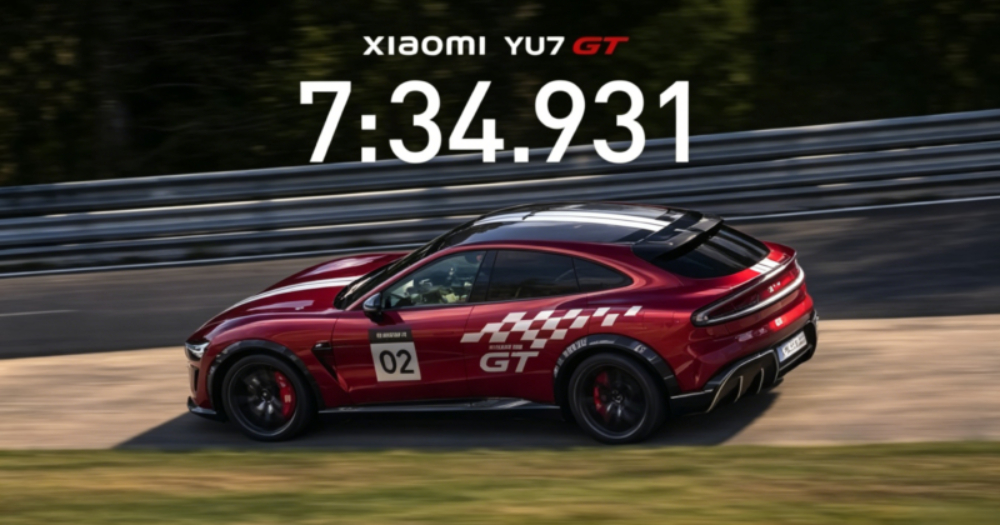
Xiaomi's YU7 GT has claimed the Nürburgring SUV lap record with a time of 7:34.931, beating the Audi RS Q8 Performance's 2024 benchmark of 7:36.698. The electric SUV is set to debut officially on May 21 in China, where showroom display units have already begun appearing across 268 stores in 82 cities. No US sale is planned.
Power and hardware
The YU7 GT runs a dual-motor all-wheel-drive setup producing a combined 990 hp (738 kW) — 386 hp at the front axle and 604 hp at the rear. Xiaomi says top speed is 300 km/h (186 mph). The rear motor is branded HyperEngine V8S EVO, spinning to 28,000 rpm and built around a silicon-carbide power module Xiaomi developed in-house; the company claims a 5.9% performance gain and 98.38% efficiency versus the prior unit.
Chassis work was done partly at the Nürburgring itself, which Xiaomi credits to its Munich R&D; center — staffed with engineers from Porsche, Mercedes-Benz, and Lamborghini. The suspension uses CDC adaptive dampers (independent compression and rebound tuning), dual-chamber air springs, and a rear electronic limited-slip differential (eLSD) for faster torque distribution between the rear wheels.


Xiaomi YU7 GT
The YU7 GT is a five-seat SUV measuring 197.4 inches long, 79.0 inches wide, and 62.9 inches tall on a 118.1-inch wheelbase — about 1.7 inches longer than the Ferrari Purosangue. Battery capacity is 101.7 kWh. Xiaomi claims up to 705 km of range on the Chinese CLTC test cycle (China's lab standard, typically more generous than the EPA's real-world measurement); an EPA-equivalent figure has not been provided. A 0–60 mph time has not been disclosed.
Context: a record with caveats
The lap was recorded under Nürburgring certification rules, but onboard video footage has led some outlets to note possible Track Package modifications and a potentially stripped interior — Xiaomi has not confirmed whether the production version sold to customers matches the record car's specification exactly.
Not coming to the US
Xiaomi EVs have no US sales presence and face Section 301 tariffs on Chinese-manufactured vehicles that would compound already significant cost barriers. The brand has a separate European launch targeted for 2027, though EU tariffs of 30.7% on new Chinese EVs would push estimated pricing well above $85,000 before local taxes.
The record still marks a notable step for a company that only entered the car business in 2024. Its SU7 Ultra sedan previously set a production EV lap record and later posted a 6:22.091 time at the Nordschleife — placing it among the fastest certified production cars ever around the circuit.

